My Story
My earliest years were spent in the Lithuanian countryside with my grandmother. Self-sufficient living — fresh produce, honey from our own bees, foraging in the forest, swimming in lakes, picking berries until our hands were stained. My great-grandmother knew every plant in the forest and never saw a doctor in her life. There was always something drying in the rafters, always a jar steeping on a windowsill. Nobody called it anything special. It was just the way things were done.
Then life shifted. A different country, concrete instead of soil, a world that moved at a pace my body never quite matched. I spent years away from all of it — disconnected, becoming someone else entirely. There were moments of return along the way: a year on a quiet island where I went plant-based and started meditating for the first time. Time spent in the Caribbean learning from people who still lived close to the earth and its plants. But it took a flood — a real one, water rising while I was heavily pregnant — to wash away everything I'd been holding onto that wasn't mine.
That is when I came back. Not to the country, but to the knowing. To the rhythm my grandmother's hands had taught me before I had words for it. KoraKira grew from there — from the need to ground myself, to reconnect above and below, and to offer that same steadying to anyone who needs it.
The Lineage
Lithuania was the last country in Europe to accept Christianity. For centuries, our people kept the old faith -- a living relationship with the earth, the trees, the fire, the fate that weaves through all things. These are the deities who walked with my grandmothers, and who walk with me still.
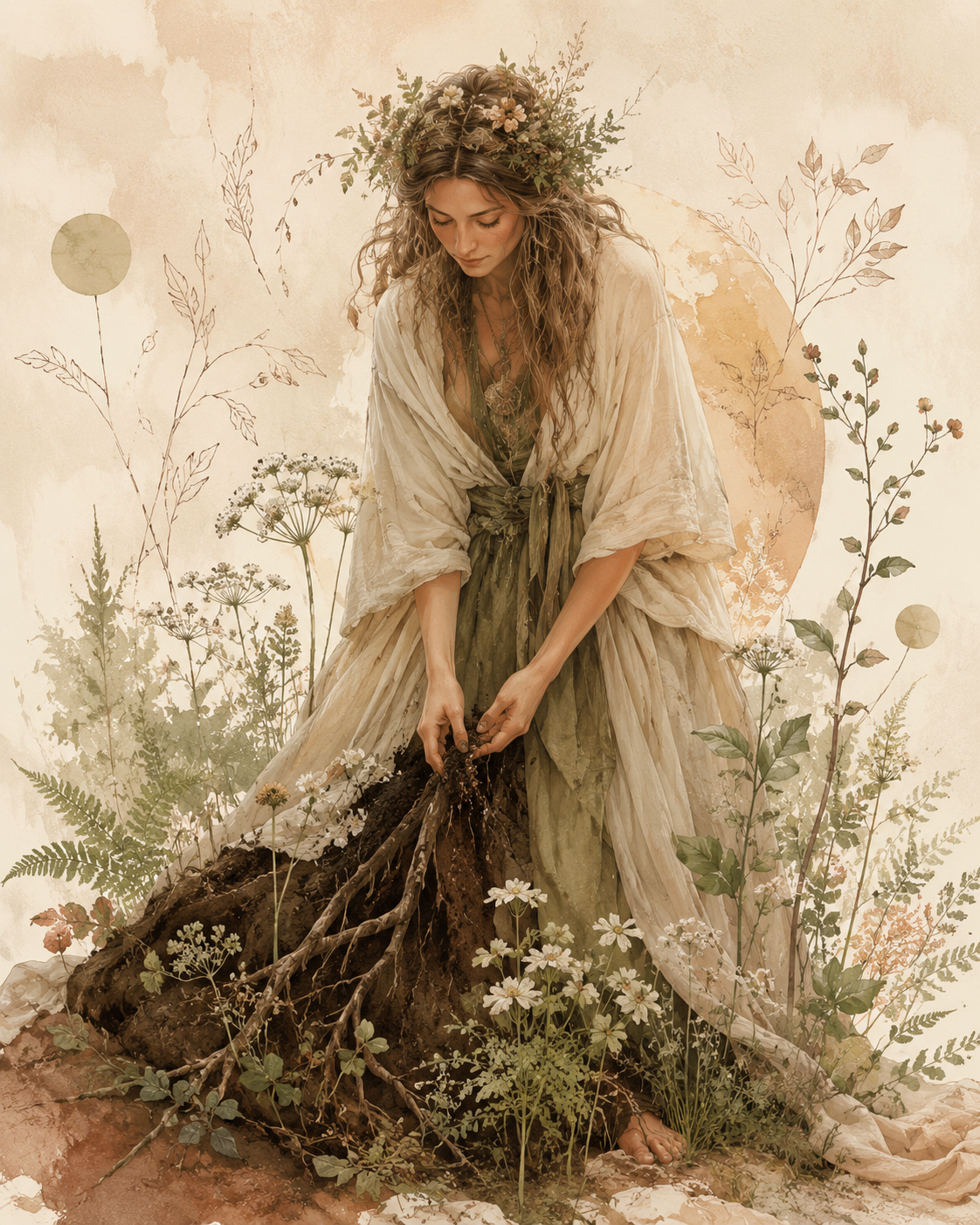
Žemyna
Earth Mother
She who holds every root and receives every seed. The ground beneath our bare feet. We kissed the earth to honour her.
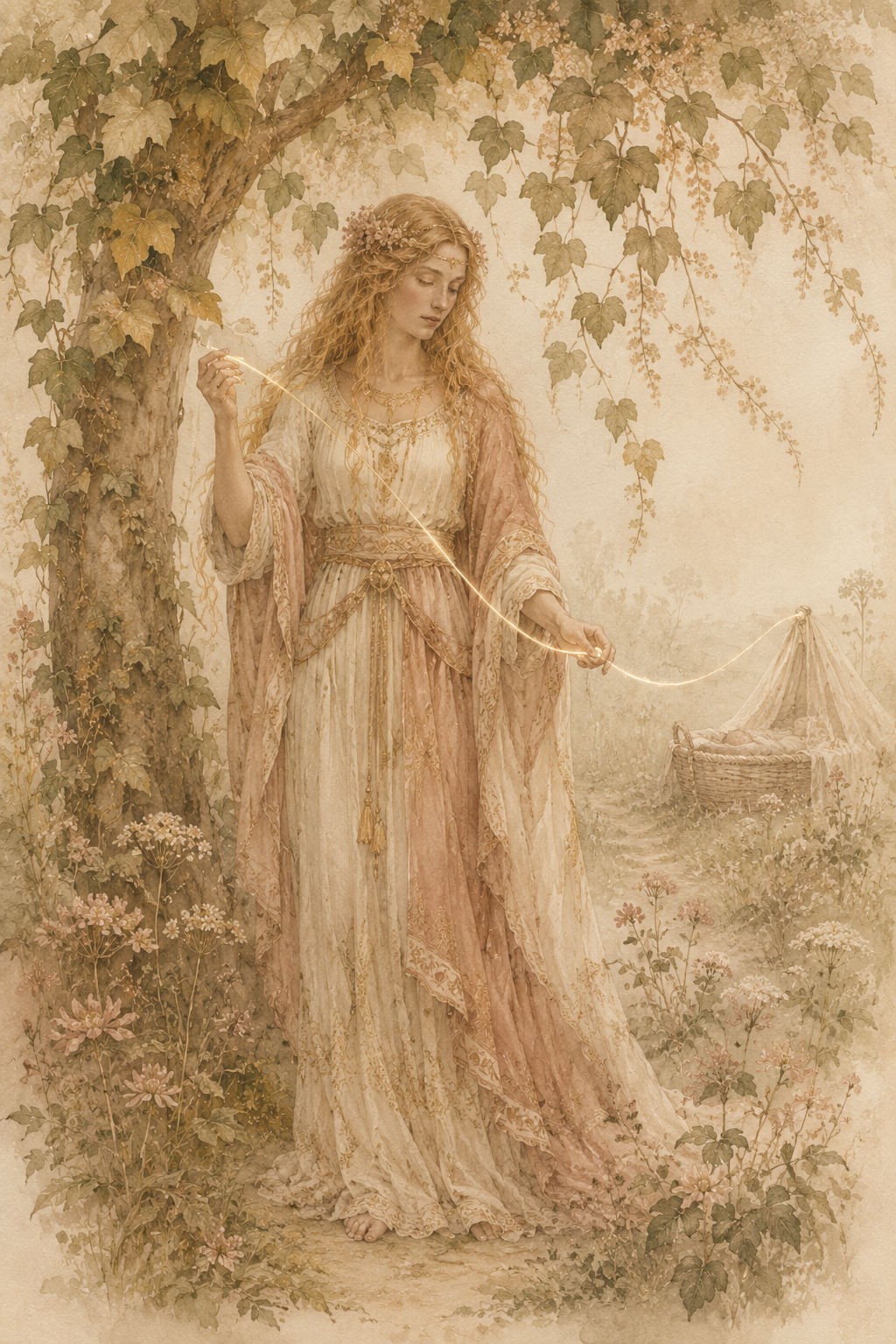
Laima
Goddess of Fate & the Linden
She who spins destiny beneath the linden tree. Protector of mothers, keeper of the thread that connects birth to death.
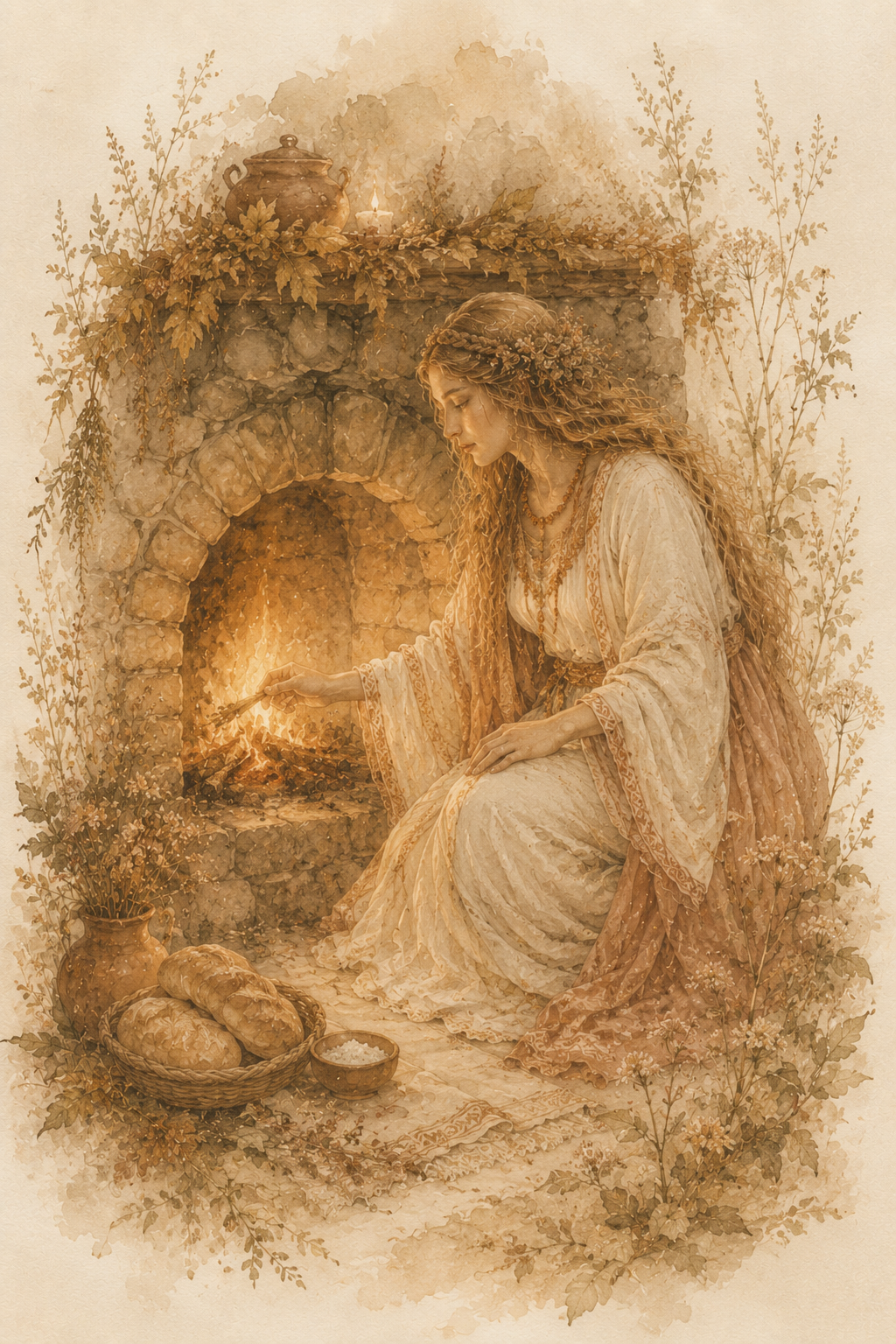
Gabija
Guardian of the Hearth Fire
The sacred flame that warms the home and guards the family. We fed her bread and salt. She kept the darkness at bay.
Perkūnas
God of Thunder & Justice
He who strikes the sky and cleanses the earth. Guardian of order, truth, and the oak tree. His thunder shook loose what no longer served.
Dievas
Sky Father & Creator
The shining one above all. He oversaw the harmony of the world, the turning of seasons, and the balance between light and dark.
Saulė
Goddess of the Sun
She who rides across the sky in a chariot of copper and gold. Mother of warmth, light, and all growing things. Every sunrise is her return.
Mėdeina
Goddess of the Forest & Hunt
She who runs with wolves and hares through the ancient woods. Protector of wild things, keeper of the untamed places where the old ways still breathe.
Austėja
Goddess of Bees & Harmony
Guardian of the hive, weaver of sweetness and order. She taught that community thrives when each soul tends its purpose — like bees tending their queen.
Giltinė
Goddess of Death & Passage
She who comes with a poisoned tongue to end what must end. Not feared, but honoured — for without death, there is no turning of the wheel, no room for what comes next.
Pergrubė
God of Spring & Growing Things
He who wakes the frozen ground and calls the first green shoots through the soil. When Pergrubė stirs, the earth remembers how to begin again.
We carry the knowledge of our grandmothers in our hands.
A note on what I do and don't offer: I share ancestral plant knowledge, seasonal practices, and the things I've learned from my lineage and my own research. I do not offer 1:1 consultations, medical advice, or diagnoses. Everything here is educational and rooted in tradition -- take what serves you and leave what doesn't.
The Soil I Come From
Lithuania is a small country with an ancient soul. Everything I share through KoraKira is rooted in this land — its language, its seasons, its stories, and the way its people have lived for thousands of years.
The Oldest Living Words
A language that remembers what others forgot
Lithuanian is one of the most archaic living Indo-European languages on earth. Linguists have long marvelled at how closely it mirrors Sanskrit — the ancient sacred language of India. The 19th-century scholar August Schleicher said a Lithuanian peasant could understand simple Sanskrit phrases. This is not coincidence. It is memory held in the mouth.
Every Lithuanian word carries meaning. Our names come from nature — Eglė (spruce), Rūta (rue), Aušra (dawn), Gintarė (amber). Our months tell us what the land is doing: Birželis (birch month), Liepa (linden month), Rugpjūtis (rye harvest), Lapkritis (leaf fall), Gruodis (frozen ground).
A Land of Water, Forest & Light
The geography that shaped everything
Lithuania is one of the greenest, cleanest countries in Europe. Forests cover a third of the land — mostly pine, spruce, and birch — and the country holds nearly 3,000 lakes, with vast underground water reserves beneath the surface. The air has a scent you notice the moment you step off the plane: pine resin, damp earth, something impossibly clean.
The Baltic Sea borders the west, and there — stretching 98 kilometres between sea and lagoon — lies the Curonian Spit, a UNESCO World Heritage Site. A ribbon of sand dunes, some rising over 50 metres, so fragile and so beautiful that large parts are protected from human foot. The Parnidis Dune near Nida is one of the tallest shifting sand dunes in Europe.
On the spit, tucked into the forest near Juodkrantė, is Raganų Kalnas — Witches' Hill. A winding trail lined with nearly 80 wooden sculptures carved by Lithuanian folk artists: witches, devils, spirits, tricksters, and mythological creatures that every Lithuanian child knows by name.
~3,000 lakes
Plus vast underground water reserves beneath the surface
33% forest
Pine, spruce, birch — a third of the country is woodland
98 km spit
Curonian Spit — UNESCO World Heritage since 2000
Amber — Tears of the Sea
Gintaras: the gold of the Baltic
Baltic amber is 40 to 60 million years old — fossilised tree resin from ancient forests that once covered northern Europe. Lithuania sits at the heart of the world's richest amber deposits, and for millennia, amber was the most precious thing the Baltic had to offer the world.
The Amber Road — an ancient trade route as significant as the Silk Road — carried Baltic amber south through Central Europe to the Adriatic, and onward to Rome, Greece, and Egypt. Baltic amber has been found in Mycenaean tombs and Egyptian burial chambers. The Roman historian Tacitus wrote about the Aestii — the Baltic peoples — and their amber gathering in 98 CE. Lithuania's connection to the Mediterranean is not new. It is thousands of years old.
In Baltic tradition, amber was called gintaras and worn for protection. Placed on newborns, burned as incense for purification, and carried as a talisman against illness. The legend of Jūratė and Kastytis says amber pieces washing ashore are fragments of the sea goddess's palace, shattered by the thunder god's fury.
Stories Every Lithuanian Carries
The legends that shaped our understanding of the world
Jūratė and Kastytis
The sea goddess Jūratė lived in a palace of amber beneath the Baltic waves. She fell in love with a mortal fisherman, Kastytis, and brought him to her underwater world. When Perkūnas, god of thunder, learned of this forbidden love, he destroyed the amber palace with a bolt of lightning. To this day, fragments of amber wash ashore — pieces of Jūratė's shattered home, carried by her tears.
The Iron Wolf — Geležinis Vilkas
Grand Duke Gediminas, hunting in the hills above the Neris river, dreamed of a great iron wolf standing on a hilltop, howling with the force of a hundred wolves. The priest Lizdeika interpreted the dream: build a city here, and it will be as strong and as famous as the wolf's howl. Vilnius — the capital of Lithuania — was founded on that hillside in 1323.
Eglė, Queen of Serpents
A young girl named Eglė found a grass snake in her clothes after swimming. The snake spoke — demanding she come to the sea and become his bride. She went, and the serpent king Žilvinas revealed himself as a man. They lived happily in the underwater kingdom and had children. But when Eglė returned to visit her family, her brothers killed Žilvinas. In her grief, Eglė turned herself and her children into trees — the spruce, the oak, the birch, and the trembling aspen.
The Old Ways, Still Living
Pagan holidays, straw gardens, charm work & the rhythm of the land
Lithuania was the last country in Europe to accept Christianity — not until 1387. The old faith didn't disappear. It folded itself into daily life, into the holidays, into the things our hands still know how to make.
Joninės / Rasos
Midsummer solstice. Bonfires, jumping over flames, floating flower wreaths on water, searching for the mythical fern blossom
Užgavėnės
The farewell to winter. Masked processions, the burning of Morė, the battle between Lašininis (fat) and Kanapinis (hemp). Pancakes for everyone
Kūčios
Christmas Eve. Twelve meatless dishes, straw under the tablecloth, divination by candlelight. The most sacred night of the year
Žolinė
Herb Day, August 15. The gathering and blessing of herbs. Bundles of plants carried to be consecrated — a tradition older than the church that adopted it
Kaziuko Mugė
St. Casimir's Fair in Vilnius. Dried flower bouquets called verbos, heart-shaped gingerbread, and centuries of craft displayed in the old town streets
Vėlinės
All Souls. Every cemetery in the country glows with candles. We visit our dead, tend their graves, and sit with them in the dark
Kanklės
The Lithuanian plucked string instrument, ancient cousin of the Finnish kantele. Its sound is thin and clear — like water over stones. Played for centuries at gatherings, rituals, and quiet evenings
Sutartinės
Polyphonic songs sung by two or three women in overlapping voices. Meditative, repetitive, almost trance-like. UNESCO recognised them as a masterpiece of intangible heritage
Woven Patterns
Lithuanian linen was woven on heavy wooden looms with geometric patterns that carried meaning — each region had its own motifs. The cloth itself was a language, telling others where you came from
Ancient Zodiac
Lithuania had its own system of geometric symbols — suns, moons, stars, serpents, and tree-of-life motifs carved into distaffs, crosses, and doorframes. Cosmic order made visible
Sodai
Geometric straw gardens — suspended ornaments threaded into pyramids and polyhedra that spin slowly in the air. Hung for Christmas and weddings. The cosmos in straw
Household Herbs
Chamomile, linden blossom, mint, calendula, St. John's wort, valerian — every Lithuanian household knew these plants. Dried in bundles, steeped in jars, passed down without textbooks
Žolininkės — the charm women — carried knowledge of plants and spoken charms (užkalbėjimai) passed orally from mother to daughter across generations. This was not witchcraft. It was care — knowing which plant eases which burden, which words to speak over a feverish child, which roots to steep in winter. The knowledge was as ordinary as bread-making and as precise as prayer.
Linen and hemp were the fabrics of Lithuanian life. Flax was cultivated, spun, and woven for centuries on heavy wooden looms that took up half the room. Linen clothed us, wrapped our dead, decorated our ritual tables. But the cloth was more than material — each woven pattern was a message. Geometric motifs told others which region you came from, whether you were married, what your family honoured. The patterns were a language spoken through thread. Hemp gave us rope, oil, food, and cloth. Both crops are woven into our folk songs, our proverbs, our muscle memory. Lithuanian linen is still sought after around the world.
Sutartinės — the ancient polyphonic songs — were sung by two or three women whose voices wove in and out of each other in overlapping, repetitive patterns. Not performance, but practice. Meditative, almost trance-like, sung while working, walking, grinding grain. UNESCO recognised them as a masterpiece of intangible cultural heritage. When I hear recordings of sutartinės, something in my chest remembers a rhythm I never consciously learned.
What My Hands Remember
The things that stayed in my body long after I left
Peeling kidney beans by hand for a whole day, sitting on the floor, playing in the pile of them like they were treasure. Swimming in wheat in my aunt's barn — burying myself in the grain until only my head stuck out, warm and dusty and golden. Peeling potatoes from the age of four, standing on a stool at the kitchen table, doing it badly but doing it. In the kitchen from as young as I can remember.
Outside, I pretended to cook — cutting herbs with blunt scissors, arranging them on leaves like plates. I remember cutting Queen Anne's lace and the smell of lilacs on a summer morning. The sun rising and coming in through the window at six, the cockerel crowing, and the whole day already begun. Running outside barefoot to open the greenhouse, pick up the eggs, swing on the swing, eat cucumbers straight off the vine with honey drizzled on top.
These are not memories I chose to keep. They kept themselves. They are the reason KoraKira exists — because my body never forgot what living close to the earth felt like, even when my mind tried to move on.
Living Close to the Earth
The Lithuania I carry is a country of rich, dark soil. Sunflower fields stretching to the treeline. Rye and potatoes pulled from the ground by hand. Snowy winters so deep and so quiet that the only sound was the crack of ice and the hiss of wood in the stove. Farm life was not romantic — it was hard, honest, and complete. Everything we needed came from the land, and what we took, we gave back.
This is the world my grandmother lived in. This is the rhythm KoraKira is trying to remember — not to recreate, but to honour. The connection between the Baltic and the Mediterranean is older than any border. Amber moved south, olive oil moved north. The trade routes that carried our gold to Rome are the same invisible threads that brought me to the south of Europe, where I live today. Some paths are older than we know.
What I Believe
Grounding
Before we can grow, we have to land. Feet on the earth, hands in something real. That is where everything begins.
Above and Below
Connected to something higher, rooted in something deep. The work is finding the middle — being fully human while honouring the ancient.
Ritual
Not ceremony for ceremony's sake. The quiet, repeated actions that give a life its rhythm — morning tea, seasonal turns, the way you close the day.
Ancestral Wisdom
What our grandmothers knew didn't come from textbooks. It came from paying attention, season after season. That knowledge lives in the body. We carry it forward.
Gentleness
The most powerful shifts happen quietly. A cup of tea. A moment of stillness. The soft authority of patience over force.
Authenticity
I share only what grows from my own soil. No borrowed practices, no performance of wellness — just honest living, honestly offered.